Learn How To Size A Sump Pump So Your Sump Pump Can Keep Up With Heavy Rains And Not Short Cycle During Small Rains. We Show You How To Get The Right Size.
Learning How To Size A Sump Pump is key to preventing a flooded basement during heavy rainstorms; however it is important to understand what happens during heavy rainstorms. Here are the topics we cover.
How Does Water Flow To The Sump Basin?
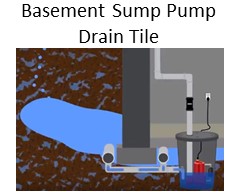 During heavy rainstorms, the water comes down the roof into the gutters and onto the ground. The rain also goes directly onto the ground around the house. The ground eventually becomes saturated and the excess water needs someplace to go. This is when the drain tile around the house perimeter begins to get the ground water seepage. As the drain tile fills up with water, it needs somewhere to go. The drain tile is angled downward toward the direction of the drain tile leading into the sump basin in the basement.
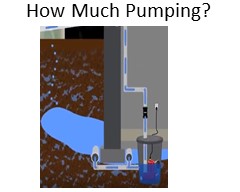 As the water drains into the basin, it begins to move the float upward. When the float reaches it preset ON height, the switch completes the electrical circuit which in turn gives power to the sump pump motor which turns on and begins to pump the water from the basin, up the PVC discharge pipe and out and away from the house. This action continues until the water in the pit goes below the float ON height. The key to sizing a sump pump is to determine what size is needed and how much pumping capability it needs.
How To Size Your Sump Pump
So how do you determine the size for your sump pump?
First of all, let’s understand what the pump manufacturer provides to help.
Pumps Static Head
Each manufacturer is required to provide a Pumps Static Head Table. This table will tell you how much water their sump pump can pump per minute or hour at a specific vertical height.
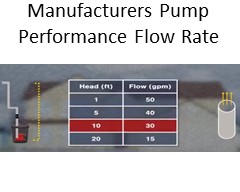 For example, this Pump performance chart gives a pump flow rate of 50 GPM, 40, 30 and 15 GPM.
To use the Flow Rate, the vertical height (the Head Feet) at which the water is being pump needs to be identified because the greater the vertical height, the harder the pump must work and the lower the water flow rate becomes.
The Head Feet in this example is 1 feet, 4, 10 and 20 head feet (vertical feet)
If the Flow Rate (GPH) and the Head Feet (Vertical Height) are used together, we see that a the sump pump used in our illustration has a vertical height of ten feet to push the water up; therefore the flow rate of gallons of water per minute is 30 gallons (GPM).
How To Use The Pump Performance Table
Steps to using the Pump Performance Table
1) Before a rainy day, take a yardstick and measure the distance from the basin bottom to the float bottom. This means the pump should not be running. Let’s say it is 6 inches.
2) Measure the diameter of the basins top. Usually it will be 18 or 24 inches. Each inch of an 18 inch diameter basin represents 1 gallon of water in the basin. Each inch in a 24 inch diameter basin represents 2 gallons of water. So 6 inches in the basin when the water is below the float represents 6 gallons of water remaining in the pit.
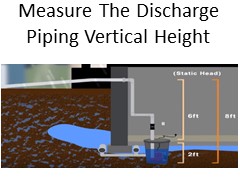 3) Measure the vertical height (static head) of the discharge pipe. Let’s say it is 8 feet.
4) Wait for a heavy rainy day. Use a yardstick to measure the height of the water when the float reaches the ON level and the pump begins to run. Let’s say the water was at 13 inches when the pump came on.
5) The distance between the Float OFF and ON level is 7 inches. 7 inches of water represents 7 gallons of water in an 18 inch diameter pit. If you have your sump pump manual the manufacturer will tell you the float ON and OFF point so you will not need to measure that.
6)  Watch the clock. Count how many times the pump runs in 1 minute (60 seconds). Let’s say it runs 6 times.
7) Now we can calculate how much water is pumped in 1 minute. Each time the pump runs we determined 7 gallons were pumped. So if the pump runs 6 times in one minute, the water pumped is 42 gallons per minute. That’s a lot of water for a sump pump.
8) To be safe, let’s build a safety factor into our calculation in case a heavier rainstorm comes someday. Let’s give a safety factor of 25%. So 42 GPH times 1.25% is 52.5 gallons per minute.
9) Let’s look at one of the manufacturers pump performance tables. We decided our head height was 8 feet and our flow rate was 52.5 GPH. This 1/3 HP basement submersible sump pump cannot handle the flow of water into our pit. At an 8 foot vertical height it can only handle between 30 and 40 gallons. So we will need to look for a 0.5 or 0.75 HP pump.
See How To Size A Sump Pump In Action
The following video will show you how Amry Supply sizes a sump pump.
Conclusion
Learning how to size a sump pump is very helpful. The implementation of the steps can prevent you from buying too small of a sump pump and ending up with a flooded basement. Or on the other hand buying too big of a pump so it keeps short cycling and burning the motor out prematurely.
Before you buy your next replacement sump pump, perform the steps outlined above. Check the pumping performance of your current pump brand model. Does the manufacturers pump performance table indicate you have a right sized pump for your basin?
The best time to prepare for a basement replacement sump pump is before you actually need one. Remember going by horse power alone is not enough. Some one-third HP pumps have almost as much capability as a one-half HP, but some one-half horse power pumps usually do not have the same capability as a three=quarters HP pump.
If you have a hard time finding the manufacturers pump performance table, check our site. We have the charts from the most popular manufacturers.
Happy Sump Pump Sizing!